

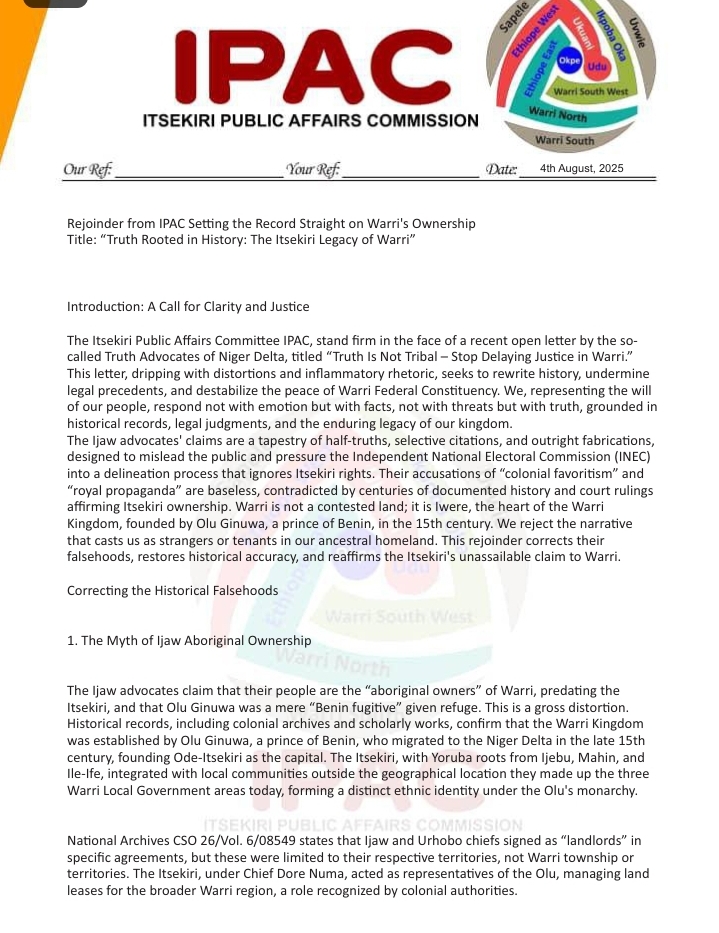
IPAC Rejoinder To Ogbe-Ijoh: Setting the Record Straight on Warri’s Ownership
Title: “Truth Rooted in History: The Itsekiri Legacy of Warri”
Introduction: A Call for Clarity and Justice
The Itsekiri Public Affairs Committee IPAC, stand firm in the face of a recent open letter by the so-called Truth Advocates of Niger Delta, titled “Truth Is Not Tribal – Stop Delaying Justice in Warri.” This letter, dripping with distortions and inflammatory rhetoric, seeks to rewrite history, undermine legal precedents, and destabilize the peace of Warri Federal Constituency. We, representing the will of our people, respond not with emotion but with facts, not with threats but with truth, grounded in historical records, legal judgments, and the enduring legacy of our kingdom.
The Ijaw advocates’ claims are a tapestry of half-truths, selective citations, and outright fabrications, designed to mislead the public and pressure the Independent National Electoral Commission (INEC) into a delineation process that ignores Itsekiri rights. Their accusations of “colonial favoritism” and “royal propaganda” are baseless, contradicted by centuries of documented history and court rulings affirming Itsekiri ownership. Warri is not a contested land; it is Iwere, the heart of the Warri Kingdom, founded by Olu Ginuwa, a prince of Benin, in the 15th century. We reject the narrative that casts us as strangers or tenants in our ancestral homeland. This rejoinder corrects their falsehoods, restores historical accuracy, and reaffirms the Itsekiri’s unassailable claim to Warri.
Correcting the Historical Falsehoods
1. The Myth of Ijaw Aboriginal Ownership
The Ijaw advocates claim that their people are the “aboriginal owners” of Warri, predating the Itsekiri, and that Olu Ginuwa was a mere “Benin fugitive” given refuge. This is a gross distortion. Historical records, including colonial archives and scholarly works, confirm that the Warri Kingdom was established by Olu Ginuwa, a prince of Benin, who migrated to the Niger Delta in the late 15th century, founding Ode-Itsekiri as the capital. The Itsekiri, with Yoruba roots from Ijebu, Mahin, and Ile-Ife, integrated with local communities outside the geographical location they made up the three Warri Local Government areas today, forming a distinct ethnic identity under the Olu’s monarchy.
National Archives CSO 26/Vol. 6/08549 states that Ijaw and Urhobo chiefs signed as “landlords” in specific agreements, but these were limited to their respective territories, not Warri township or territories. The Itsekiri, under Chief Dore Numa, acted as representatives of the Olu, managing land leases for the broader Warri region, a role recognized by colonial authorities.
Prof. P.A. Talbot, “The Peoples of Southern Nigeria,” Vol. II (1926) notes the Itsekiri’s migration under Ginuwa but emphasizes their establishment of a centralized kingdom, distinct from scattered Ijaw settlements in what today makes up Bomadi Loval Government Area. The claim that Ijaws “allowed” Ginuwa to settle reverses the historical reality of Itsekiri sovereignty.
The Ijaw’s assertion that they predated the Itsekiri in Warri township is unsupported by evidence. Warri’s core, including Okere, Igbudu, Agbassa, Ugbori, Ekurede, Odion, Pessu and Ode-Itsekiri, has been Itsekiri territory for centuries, as affirmed by court rulings and colonial records.
2. The “Olu of Warri” Title Misrepresentation
The Ijaw letter claims the title “Olu of Warri” was a 1952 colonial creation to extend Itsekiri influence over non-Itsekiri lands, citing CO 554/120/5 (1952). This is a deliberate misreading. The title change from “Olu of Itsekiri” to “Olu of Warri” reflected the kingdom’s historical scope, encompassing Warri township and its environs, not a new claim. The resistance noted in the colonial file came from specific Ijaw and Urhobo communities disputing administrative boundaries, not the Itsekiri’s ancestral rights.
CO 554/120/5 (1952) records Ijaw and Urhobo objections but does not negate the Itsekiri’s historical presence or the Olu’s authority over Itsekiri lands. The file notes the title change as a clarification of existing jurisdiction, not an expansion.
Prof. Philip A. Igbafe, “Benin Under British Administration” (1979) confirms the Olu’s authority was rooted in Itsekiri-speaking areas, with Warri township as the kingdom’s heart, not a multi-ethnic freehold as claimed.
The Olu’s title reflects the Itsekiri’s cultural and historical reality, not a colonial fiction. The Ijaw’s attempt to frame it as an imposition ignores the monarchy’s pre-colonial roots, documented since the 15th century.
3. Misinterpretation of Court Rulings
The Ijaw letter cites Shell v. Tiebo VII (1996), Sillo v. Military Governor (1973), and Ojakovo v. Ajomiwe (1961) to claim Ijaw and Urhobo ownership over Warri lands. These cases are misapplied:
Shell v. Tiebo VII (1996) 4 NWLR (Pt. 445) 657 affirmed Ijaw right of specific community lands in Gbaramatu Kingdom, not Warri township or the broader Warri Federal Constituency. This is not a case of ownership of Warri land.
Chief E.E. Sillo & Ors v. Military Governor of Mid-Western State (1973) upheld Ijaw rights in Ogbe-Ijoh, a distinct community in Warri South-West, not Warri township. The court recognized Itsekiri as the owners of Ogbe Ijaw land.
Ojakovo v. Ajomiwe (1961) confirmed Urhobo possessory right of 210 acres in Okere, a specific area within Warri South, but did not negate Itsekiri overlordship in Warri township, as established in earlier cases like Ometa v. Chief Dore Numa (1926).
In contrast, Itsekiri ownership is supported by a robust legal record:
Ometa v. Chief Dore Numa (1926) 11 N.L.R. 18 (Privy Council) confirmed Itsekiri ownership of Agbassa land in Warri, rejecting claims by other groups.
Omagbemi v. Chief Dore Numa (1923) 5 N.L.R. 17 upheld Itsekiri ownership rights over Ogbe-Ijaw and Alder’s Town, affirming the Olu’s overlordship.
Chief Secretary to the Fed. of Nigeria v. Itsekiri Communal Lands Trustees (W/41/57, 1970) recognized Itsekiri ownership of Igbudu, Warri, under the Olu’s authority.
The Ijaw’s selective use of court rulings ignores this catena of judgments affirming Itsekiri rights, misrepresenting isolated decisions to claim broader ownership.
4. The Ginuwa Narrative
The claim that Ginuwa was a “fugitive” given refuge by Ijaws inverts history. Olu Ginuwa, a Benin prince, founded the Warri Kingdom with his followers, establishing Ode-Itsekiri as its capital. The Ijaw, while present in riverine outside Warri areas, were not found inside Warri Kingdom as at the time of Ginuwa migration. Colonial records and oral traditions confirm Ginuwa’s followers integrated with local Yoruba-related groups, forming the Itsekiri identity.
Prof. Obaro Ikime, “Groundwork of Nigerian History” (1980) distinguishes between the Itsekiri people, who predate the monarchy, and Ginuwa’s establishment of the kingdom, centered in Warri township.
CO 554/124/3 (1938) clarifies Itsekiri claims in Ijaw areas like Ogbe-Ijoh and affirms their customary rights in Warri township.
The Ijaw’s narrative of hosting Ginuwa is a fabrication, unsupported by primary sources or archaeological evidence.
The INEC Delineation Process: A Call for Fairness
The Ijaw letter accuses INEC of delaying the ward delineation ordered by Timinimi v. INEC (SC/CV/1033/2023) due to Itsekiri pressure. This is a distortion. The Itsekiri have not opposed delineation but demand a process that respects historical and legal realities. The Ijaw’s claim of demographic dominance is exaggerated, relying on manipulated data and ignoring Itsekiri settlements.
INEC Ward Assessment Survey (2022) is cited by the Ijaw, but its findings are contested. Itsekiri Leaders of Thought, in a 2024 Vanguard publication, noted that INEC’s data collection was incomplete, failing to account for Itsekiri communities like Ugborodo and Omadino, which host significant populations.
Sunny Amorighoye, Channels Television (2025) highlighted the balanced ward structure in Warri North and South-West (six Itsekiri wards, four Ijaw wards), which the Ijaw’s proposed delineation threatens to disrupt, favoring their communities disproportionately.
The Itsekiri demand equity, not dominance. Warri Federal Constituency—comprising Warri South, Warri South-West, and Warri North. The Ijaw’s push for delineation based on alleged population superiority ignores Itsekiri ancestral rights, as affirmed in Ometa v. Chief Dore Numa (1926) and other cases.
Addressing the Accusations Against Itsekiri Elites
The Ijaw letter names Mrs. Daisy Danjuma and Senator Oluremi Tinubu as “shadowy influencers” pressuring INEC. This is baseless slander. No evidence links these women to INEC’s actions, and their inclusion is a tactic to inflame tensions. The Itsekiri rely on legal and historical arguments, not political lobbying. The Premium Times (March 3, 2024) report cited by the Ijaw lacks specifics, relying on unverified “whispers” in political circles, which do not constitute evidence.
The Itsekiri elite, including Chief Edward Ekpoko, have engaged INEC through lawful memoranda, as at the 2025 South-South Zonal Hearing, demanding a Warri State to protect Itsekiri rights, not to obstruct delineation. Their advocacy is transparent, unlike the Ijaw’s accusations of “gunrunning” and “militias,” which lack proof and echo past inflammatory rhetoric that fueled the 1997 and 2003 Warri crises.
The OPC’s Role: A Mischaracterized Ally
The Ijaw letter vilifies the Oodua People’s Congress (OPC) as “saboteurs” with no stake in Warri. The OPC’s 2025 statement, reported by Tribune Online, expressed concern over INEC’s delineation, citing irregularities like renaming Itsekiri communities and favoring Ijaw wards. This aligns with Itsekiri grievances, rooted in shared Yoruba heritage, not external interference. The OPC’s call for adherence to court judgments, like Ometa v. Chief Dore Numa, is a defense of legal precedent, not a threat. The Ijaw’s warning of “consequences” is reckless, risking the peace maintained since the 1997 peace talks.
The Itsekiri Counter-Case: Warri as Iwere
Warri is the heart of the Warri Kingdom, Iwere, established by Olu Ginuwa in the 15th century. Its core—Warri township, Ode-Itsekiri, Okere—has been Itsekiri territory for centuries, as affirmed by:
Legal Precedents: Cases like Ometa v. Chief Dore Numa (1926), Omagbemi v. Chief Dore Numa (1923), and Chief Secretary v. Itsekiri Communal Lands Trustees (1970) confirm Itsekiri ownership under the Olu’s overlordship.
Colonial Records: CO 554/124/3 (1938) distinguishes Itsekiri rights in Warri township from Ijaw claims in peripheral creeks, affirming the Olu’s authority.
Historical Scholarship: Prof. Obaro Ikime and others document the Itsekiri’s pre-colonial presence, with Warri as their political and cultural center.
The Ijaw’s claim to Warri township, as voiced by Victor Okumagba in 2024, ignores these records, falsely asserting no Itsekiri ancestral roots in the area. The Itsekiri acknowledge Ijaw and Urhobo presence in Warri South-West and South, but their claim to Warri township as “aboriginal” is unsupported. The Delta State Traditional Rulers Council and Chiefs Edict (1998) recognizes the Olu as the paramount ruler of Itsekiri lands, not a multi-ethnic Warri, but this does not negate Ijaw or Urhobo rights in their respective territories.
Our Demands: Equity and Truth
The Itsekiri people demand:
Fair Delineation: INEC must adhere to the Supreme Court’s order in Timinimi v. INEC (SC/CV/1033/2023), ensuring wards reflect historical and legal realities, not manipulated population claims
Respect for Precedents: Court rulings like Ometa v. Chief Dore Numa (1926) and Omagbemi v. Chief Dore Numa (1923) must guide delineation, affirming Itsekiri ownership of Warri township.
End to Inflammatory Rhetoric: The Ijaw’s threats of “consequences” and “war” must cease, as they risk repeating the 1997 and 2003 crises.
Protection of Itsekiri Rights: The Olu’s authority over Itsekiri lands must be respected, as per colonial and legal records, without prejudice to Ijaw or Urhobo rights in their territories.
Transparent Process: INEC must publish its methodology and data, addressing Itsekiri concerns about incomplete surveys and renamed communities.
Conclusion: The River’s Truth
Warri is Iwere, the heart of the Warri Kingdom, not a contested freehold. The Ijaw’s letter, with its distortions and threats, seeks to erase centuries of Itsekiri history, from Olu Ginuwa’s founding to Ogiame Dom Domingo’s legacy. We reject their narrative of “tenancy” and “colonial favoritism” as baseless, countered by legal, historical, and cultural evidence. The Itsekiri are not strangers in Warri; we are its roots, its river, its soul.
We call on INEC to uphold justice, guided by court precedents and equitable data, not pressure or propaganda. We urge the Ijaw to embrace dialogue, not division, as Warri’s strength lies in its shared heritage. The river flows for all, but its heart beats Itsekiri. Let truth prevail, not tribalism, and let Warri stand united under the law.
Signed:
Cc:
Chairman, Independent National Electoral Commission (INEC)
President of the Federal Republic of Nigeria
Chief Justice of Nigeria
National Security Adviser
Director-General, Department of State Services (DSS)
Attorney General of the Federation
Delta State Governor
Nigerian Bar Association (NBA)
National Human Rights Commission (NHRC)
Stakeholders of Warri Federal Constituency








Leave a Reply