

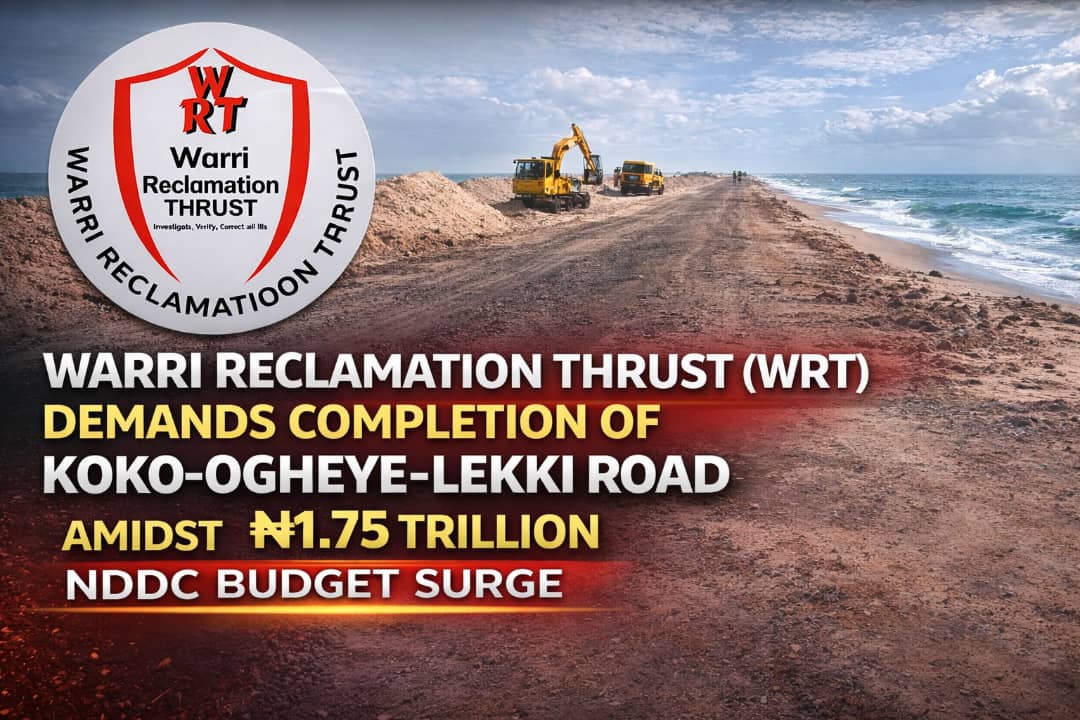
Warri Reclamation Thrust (WRT) Demands Completion of Koko-Ogheye-Lekki Road Amidst ₦1.75 Trillion NDDC Budget Surge
WARRI, DELTA STATE — The Warri Reclamation Thrust (WRT) led by it’s Convener Comr.( Mrs) Tsaye Edeyibo Mene and Secretary Comr. Misan Momorin are issuing a formal call to the Federal Government and the Niger Delta Development Commission (NDDC) to prioritize the immediate completion of the Koko-Ogheye-Lekki Road (also known as the Koko-Ogheye-Epe Road).
With the NDDC announcing its ₦1.75 trillion “Budget of Consolidation” for 2026, WRT asserts that there is no longer a financial or logistical excuse for the continued abandonment of this 67-year-old vision. This coastal corridor is the most critical infrastructure project required to unlock the economic potential of Itsekiri riverine communities and the wider Niger Delta.
A strategic Link for Regional Prosperity
The dream of the Koko-Ogheye link predates Nigerian independence, with early proposals dating back to 1959. Despite its strategic importance:
* Approval & Award: It was formally approved and awarded in 2009 for ₦14.9 billion ($100.5 million at the time) to Levant Construction Company.
* Construction History: Work commenced in 2010, but the project has since been described as largely abandoned, with minimal progress noted during inspections as recently as 2021.
* The Route: The initial 15 km phase starts in Koko (Delta State) and extends to Ogheye, traversing marshy terrain and requiring significant bridge infrastructure to eventually link with Epe and Lekki in Lagos.
*The Itsekiri Corridor*
This road is a lifeline for several Itsekiri-dominated towns and villages that have historically been isolated from the mainland economy. Key beneficiary communities include:
* Koko (Starting point)
* Ureju, Dudu Town, and Ebrohimi
* Gbokoda, Ugbege, and Jakpa
* Ogheye (Delta terminus)
*Critical Distinction:* Koko-Ogheye vs. The Lagos-Calabar Coastal Highway*
WRT seeks to clarify a common misconception: The Lagos-Calabar Coastal Highway has NOT replaced the Koko-Ogheye-Lekki Road. While the 700-km national highway is a welcome separate initiative, the Koko-Ogheye project remains a distinct, stalled NDDC effort.
The Koko-Ogheye road is a specific “inner-artery” for the Itsekiri people. National highway diversions do not fulfill the local need for this direct link, which remains an independent and urgent priority.
*2026: A Historic Opportunity for Funding*
The Warri Reclamation Thrust points to the unprecedented 2026 fiscal landscape as the perfect moment for the project’s revival:
* NDDC Consolidation (₦1.75 Trillion): The Commission’s 2026 budget marks a shift toward finishing “transformational” inherited projects rather than starting new, smaller works
* Delta State Commitment (₦450 Billion): Governor Sheriff Oborevwori has earmarked massive funding for road infrastructure, including ₦100 billion specifically for interventions in difficult riverine terrains.
* National Focus (₦3.23 Trillion): The Federal Ministry of Works is overseeing the largest road fund in Nigerian history, specifically targeting the completion of delayed and abandoned corridors.
“The Koko-Ogheye road is the missing link in our regional development,” the Warri Reclamation Thrust stated. “Completing this project would turn a seven-hour journey to Lagos into a 90-minute commute, revitalizing commerce across our coastal axis. We demand that the NDDC uses this ‘Year of Consolidation’ to finally honor the promise made to our people in 1959.”
“The Honourable Minister of Works, Hon. David Umahi, is respectfully urged to urgently intervene in the Koko–Ogheye–Lekki Road project by incorporating it into the Federal Government’s coastal road master plan.
This critical infrastructure is not merely a regional necessity but a project of profound national importance, as it will enhance coastal connectivity, boost economic activities across the Niger Delta, improve access to maritime corridors, and strengthen national integration.
The inclusion of Itsekiri communities, particularly those extending into Edo State, is essential to ensure equitable development, protect indigenous economic interests, and fully unlock the strategic potential of Nigeria’s coastal economy.
This road will serve as a vital link between Delta, Edo, and Lagos corridors, facilitating trade, improving security presence, encouraging investment, and contributing significantly to the nation’s GDP through enhanced logistics and regional commerce.”



Leave a Reply