

Ugbarajor Itsekiri Youth Correcting the Distorted History of Obitugbo Community in Warri North LGA by the Oghara People
The leadership of Ugbarajo Itsekiri Youths (UIY) find it sad that within the quiet landscape of 2026, where the Niger Delta enjoys a hard-won peace, a troubling trend has emerged: a systematic attempt to rewrite the ancestral geography of Delta State. Specifically, recent claims by the politically created Oghara Kingdom regarding the Obitugbo Community represent more than a local dispute; they are an affront to documented history, judicial reality, and the sovereign legacy of the Itsekiri people.
To understand the truth of Obitugbo, one must look past the administrative maps drawn in the 1990s and focus on the centuries-old foundations of Warri Kingdom.
Long before the advent of modern Local Government Areas (LGAs), Warri Kingdom was a recognized international power. Historical records from neutral European observers provide an empirical baseline for Itsekiri territorial rights:
1678: The traveler John Barbot recorded that the sovereign Kingdom of “Owerre” (Warri) encompassed both banks of the Benin River.
1778: Landolphe’s memoirs confirm that the Itsekiri monarch’s authority extended through the entire riverine network.
Traditional Borders: Historically, the northern frontier of the Itsekiri was not Oghara, which did not exist as a kingdom, but the Benin Kingdom, with the Itsekiri village of Ologbo serving as the traditional border post.
Ancient Foundations: The community of Efurokpe in Ethiope West was founded by Okotie Ijegbo as far back as 1027 AD. Obitugbo sits within a vibrant, millennium-old network of Itsekiri towns including Ajatiton, Aja-Uduaghan, and Obite-ukpagha.
According to Oghara oral traditions, their ancestors (including figures like Ogbojere and Ekakabor) migrated from Benin around 1880. Seeking refuge from internal disputes, they settled in Oghareki and Ogharefe.
It is a critical historical distinction that “settlement” on land does not constitute “ownership,” especially when that land was already under the jurisdiction of an existing sovereign. Furthermore, the Oghara Kingdom is a modern political entity. Prior to 1999, Oghara was part of the Idjerhe Kingdom. It was only during the James Ibori administration that it was elevated to a kingdom. To suggest that a 27-year-old monarchy has ancestral claims over the ancient lands of the Itsekiri is a historical impossibility.
Obitugbo is an Itsekiri community founded by Iyatsere Egharegbemi, a high-ranking noble of the Warri Royal Court.
Egharegbemi’s eldest son, Dandan, took control and managed the land on behalf of his siblings, eventually expanding it to accommodate immigrants.
His descendants have exercised acts of ownership for centuries, including formal leases to companies like Domez Nigeria Limited in 1976 and Tuoyo Holding Limited.
The Oghara people nick named Obitugbo “Otegbo” is a recent phonetic misnomer. The original Itsekiri name, Obite-Ugbo, describes the “waterside of the forest,” reflecting its geographical reality as an Itsekiri landing point.
The Legal Battleground: Courts vs. Rhetoric
The Oghara Traditional Council has frequently used media publications to claim ownership, yet the judicial record tells a different story:
Suit No. S/29/2001 (Abel Igorki & Ors vs. Presco Nig. Ltd & Oghara): The Obitugbo people sued for declaration of title after Oghara attempted to “give” land to Presco Nigeria Ltd.
The 2007 Injunction: On November 1, 2007, the Obitugbo Community obtained an interlocutory injunction restraining the Oghara people from entering the land, felling trees, or destroying houses.
Abandoned Appeals: Frustrated by the injunction, Oghara appealed in 2008 but failed to prosecute it, leaving the case dormant for 15 years while the injunction remained in force.
Suit No. HCH/38/2014: Oghara sued the Delta State Government and Obitugbo over boundary adjustments. After eight years of failing to provide evidence, the case was struck out in 2022 for lack of diligent prosecution.
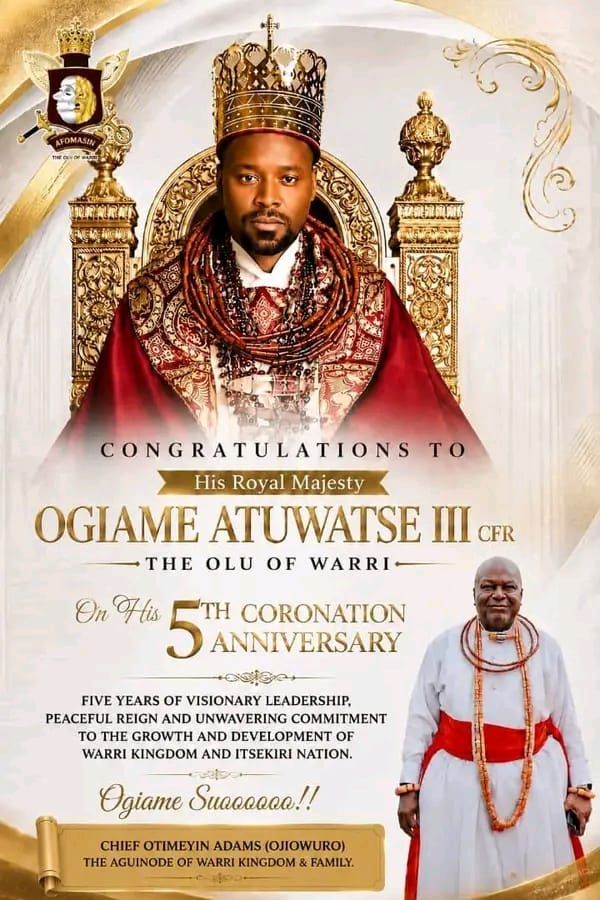
The claim that HRM Ogiame Atuwatse III, the Olu of Warri, “illegally” handed over land to the Nigerian Army or for the proposed University of Warri is fundamentally false.
The Olu of Warri is the legal and traditional overlord of all Itsekiri lands. In consenting to these projects, he is acting upon the express wish of his subjects in Obitugbo.
The presence of the Ovie of Oghara and his chiefs at Obitugbo in April 2022 for “protests” was a direct violation of the 2007 court injunction.
Ethiope West local government area was created in1991 and it houses oghara community, while Obitugbo Community is in warri north local government, were intended for governance, not for the annexation of ancestral land by the urhobos of oghara
Ownership of land is determined by history and competent law courts, not by “vituperations” in newspapers or threats of violence. The Itsekiri have always been a peaceful and welcoming people, but hospitality must not be mistaken for a lack of memory.
Obitugbo was Itsekiri land in 1027, it was Itsekiri land in 1880, and it remains Itsekiri land today. History cannot be rewritten by commission; it is etched in the soil and the bloodlines of those who have guarded it for a millennium.
Signed:
Comr. Okotie Joseph
President – UIY
Comr. Jolomi jakpa
Secretary – UIY









Leave a Reply